
Digitalization has now become a must for manufacturers. Merging IT and OT creates new opportunities for optimizing processes and establishing new workflows.
To manage digital transformation, it is essential to monitor all components involved, from machines and production facilities to environmental conditions, IT infrastructures, and networks. With a centralized monitoring solution, it is possible to track complex processes across internal boundaries, provided this solution supports all required functions and can communicate with both IT and OT devices. This is also the biggest challenge: Since OT has always been isolated from IT, there are many protocols beyond MQTT or OPC UA that are used in the OT world but are not supported out of the box by any IT monitoring solution.
PRTG Network Monitor is one of the world's leading IT monitoring solutions. By supporting industrial methods and protocols such as MQTT, OPC UA, and Modbus, PRTG extends the traditional IT portfolio and offers a monitoring solution for the consolidation of IT and OT. PRTG collects data on the availability and performance of devices, traffic, and services. The software sends alerts when predefined thresholds are exceeded and publishes monitoring data in dashboards and reports. PRTG ensures that problems with IT/OT infrastructure and traffic are detected early, enabling rapid troubleshooting and avoiding disruptions.
The Crosser platform was specifically developed for industrial IoT and for companies with many facilities and their specific requirements. Crosser's low-code platform radically simplifies the development of any integration or automation between machines, systems, and services. Crosser's cloud-based software deployment, which nevertheless enables on-premises installation and local execution, offers full flexibility for global companies.
Crosser enables real-time integration between any data sources or systems in manufacturing. The flexible, Docker-based software deployment makes it easy to start with one use case and grow from there. Crosser enables both horizontal integration between machines and vertical integration between layers in the OT/IT technology stack. Simply put: Crosser collects data from any OT device in any OT protocol, preprocesses this data, and translates it into IT protocols.
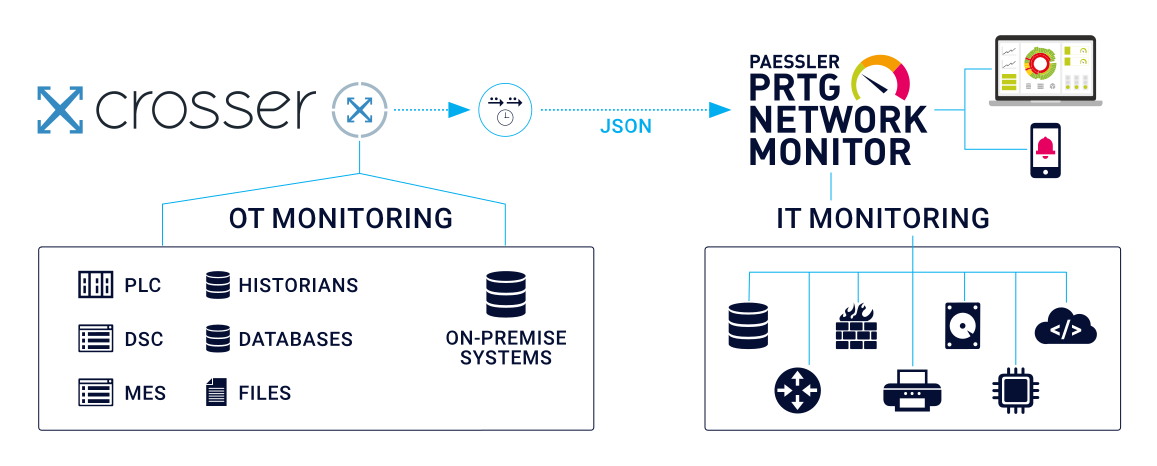
Based on Crosser's preprocessing of OT data using pre-built modules and/or machine learning algorithms, PRTG can integrate OT environments and devices into overall monitoring, including a central dashboard for IT and OT.
Crosser enables the integration of production facilities and machines into PRTG and thus the continuous monitoring of OT environments. This is based on PRTG's advanced options for alerting, notification, and data publication.
Crosser and PRTG merge IT, OT, and environmental conditions, creating a holistic overview of the entire production process.
Reduced MTTR and predictive maintenance help avoid downtime and ensure production performance.
Since 1997, we offer monitoring solutions for businesses across all industries and all sizes, from SMB to large enterprises. Today, more than 500,000 users in over 170 countries rely on PRTG and other Paessler solutions to monitor their complex IT, OT and IoT infrastructures. We believe monitoring plays a vital part in reducing humankind's consumption of resources. Our products help our customers optimize their IT, OT and IoT infrastructures, and reduce their energy consumption or emissions – for our future and our environment.
Crosser designs and develops streaming analytics and integration software for any edge, on-premises, or cloud. The Crosser platform enables real-time processing of streaming or batch data for Industrial IoT, data transformation, analytics, automation, and integration.
The solution was developed to present complex matters simply, through the Crosser Flow Studio, a visual design tool that enables teams to introduce innovations faster than ever without development effort. The software is ideal for enterprise customers from various industries and applications, including Industry 4.0, condition monitoring, predictive maintenance, and next-generation hybrid integration.
